Yes, I confess. Ever since I got my first Internet connection in 1995, while I was studying in Louvain (Belgium), I’ve been in love with the online world. I didn’t quite know how or why, but my gut told me I’d end up working in Internet. Since then, 25 years have passed (for the Internet and for me, inevitably, too…) and the Internet and its possibilities have evolved tremendously (mine, fortunately, too…).
In those early days, despite the slow connections and the hefty phone bills that came with them, I created my first personal website in 1996. On that site I shared my passions and interests and had a section where I detailed how things were going at university. It was a Blog before Blogs existed. I also built the website for the economics faculty and for a company I worked at later.
After working in direct sales and team management at OFUB — an experience that would help me enormously in my professional life — and finishing my degree, I started looking for work in Internet. Right after the dot-com bust — the best timing, right? After a few months, in 2001, I bumped into an old friend on the streets of Brussels who offered me a sales job in Internet at his company, Oniros Illusions Studio. Without thinking twice, I started the next day. Six months later they named me head of the Internet department, since apparently I was good at it — and I was happy as a clam. That’s when I decided to do a Master’s in eBusiness at Solvay Business School, since my university background was in International Relations. The Internet department was doing great, and as sometimes happens in life, a black swan appeared.
The agency’s other department was developing video games, and their project got canceled when it was already 80% complete… That drove the company into bankruptcy, my department included. But from a problem can come an opportunity, and I started thinking about solutions because I wasn’t ready to give up.
I decided to take the entrepreneurial leap, and with €20,000 that my father lent me, I created a new agency, OX2, where I recruited all the members of my former department and managed to keep all our clients since they were satisfied with our services.
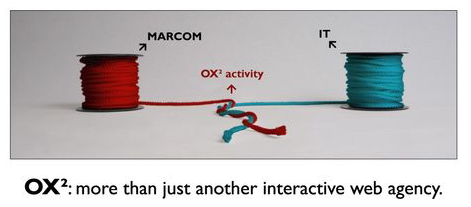

OX2 kept growing, and in the first three and a half years nobody left the ship — something I’m very proud of, given the high mobility in the market. We did, for example, all the digital developments for the RTL Group in Belgium (the Belgian Mediaset), launched all the websites for the Bridgestone Firestone Europe Group (over 100 websites in more than 30 languages). A client I really liked was Panos (the Belgian Pans & Company) — apart from various developments, we ran a campaign in 2005 integrating online and offline using eCoupons. We won the most efficient campaign of 2006 award from IAB (click here to see the presentation). Another very interesting client was Nestlé, for whom we created an eCRM project also integrating online and offline channels (see presentation).
Beyond “natural” growth, we grew especially thanks to our clients who kept pushing us further. The word impossible didn’t exist in our agency.

In 2005 we seriously started launching our Digital Analytics department. Our vision and market proposition were differentiating. In the market at that time, these products were sold to IT departments focused on the technical functioning of websites. We saw Web Analytics as a tool that needed to be in the hands of the business, the Marketing department — something that was starting to emerge in the US but not in Europe.
That’s how I used that year to launch our first specialized analytics blog and to attend international events, mainly in the US, even giving presentations. This allowed us to position ourselves globally in this field, with recognition from leaders like Avinash Kaushik, who included our blog in his top 10 analytics list (the only non-American one), or Eric T. Peterson, who ended up becoming a partner of OX2 in 2007.
We started with WebTrends, which was the market leader in Europe at the time, and landed our first major six-figure contract with Belgacom (the Belgian telecom), which helped us win the award for best WebTrends partner. Then we continued adding other alliances — Google Analytics, Unica, Omniture, IndexTools…
Starting in 2006, contracts started pouring in from other companies like Bayer or Philips at a global level, among others, to help them with their Digital Analytics.
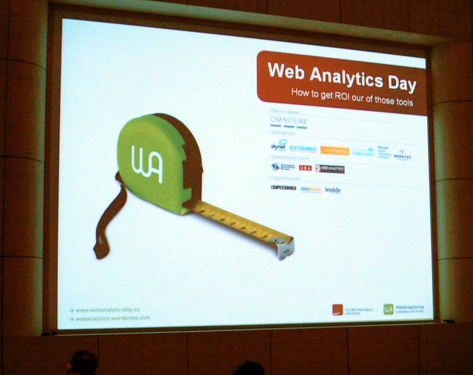
The company was doing well. I became the Country Manager for Belgium of the Web Analytics Association (now renamed Digital Analytics Association), organizing events in the country. In 2007, after launching our second Web Analytics Day (the first had taken place in 2005), my wife and I found out we were expecting. I decided it was time to sell my first child (the company) before having a second one, and I looked for a larger agency that would be interested in us. In the end I narrowed it down to two candidates, and the most “fun” part was the negotiation that succeeded — which I’ll now tell you about.
My wife and I had a first meeting on a Friday afternoon with the CEO, COO, and CFO of the agency, which belonged to an internationally listed group (LBi, now part of WPP). We talked for 4 hours at a restaurant and there was chemistry. My dilemma was that I already had the purchase/sale contract ready from the other interested agency, and even the press release prepared. We had to move fast, but they couldn’t make the decision — the global CEO had to do that. My hopes dashed…
A few hours later they called me to say the Global CEO would come on Tuesday to meet us and negotiate. For that meeting, thanks to the advice of my advisor Pieter Casneuf, I added a slide at the end of the corporate presentation with 6 boxes. In the top 3, what the other agency was offering me (what I already had on the table), and in the bottom 3 (blank), what they could offer. The first box was money at signing, the second was the potential earn-out money (when you sell a services company, they often ask you to stay for a while and based on results you get additional payments), and the third was about my team: “Nobody gets fired!” (that was one of my concerns since we had a presence in France and Germany that might not fit).
When I made the presentation and got to that slide, the Texan CEO (he even had the typical Texas boots) asked me if he had to answer right then. And the following came out of me without preparing it or even thinking about it: “No — my wife and I will go downstairs for a cigarette, so you can talk it over, and when you’re ready, give us a call.” I think he was so thrown by my assertiveness that he didn’t know what to say and accepted. I think I smoked 3 or 4 cigarettes waiting before going back up. We waited a bit in the waiting room until they called us.

Back in the meeting room, the CEO offered us more money now, more money in earn-out while even reducing the earn-out period (from 3 to 1 year), and guaranteed that nobody would be fired. I looked my wife in the eyes, turned to the CEO, extended my hand, and told him “We have a deal!”
And that’s how it went — in less than a month we signed the contract that allowed me to sell my agency for close to 1.5 million euros, which I shared with some of my employees to whom I had previously sold 20% of the shares.
Maybe in another post I’ll detail the post-sale period, which had many twists and turns ;-)
Original Comments
No comments on this post.
Before commenting, prove you're human: