In my April post about the Lego Entrepreneur vs. Playmobil Entrepreneur, I promised you this post explaining how the Internet is an ecosystem that looks a lot like Lego. A promise is a promise:

When we launched Mind Your Group in March 2012, Gemma, Aurélie, and I knew we wanted to create a group of hyper-specialized services, but it wasn’t until June of that year that I finished developing the model I’m going to explain below. This model, which I call the MYG Bow Tie (La Pajarita MYG), summarizes my vision of the digital channel and has established the roadmap for the services we’re developing for our clients.
With this model you’ll understand my vision of the Internet as an ecosystem of business processes where the customer is at the center and decisions must be data-driven. The MYG Bow Tie summarizes at a macro level the different processes that take place in the digital world in the interaction between companies and customers/users.
The MYG Bow Tie Model
The MYG Bow Tie has several reading dimensions.
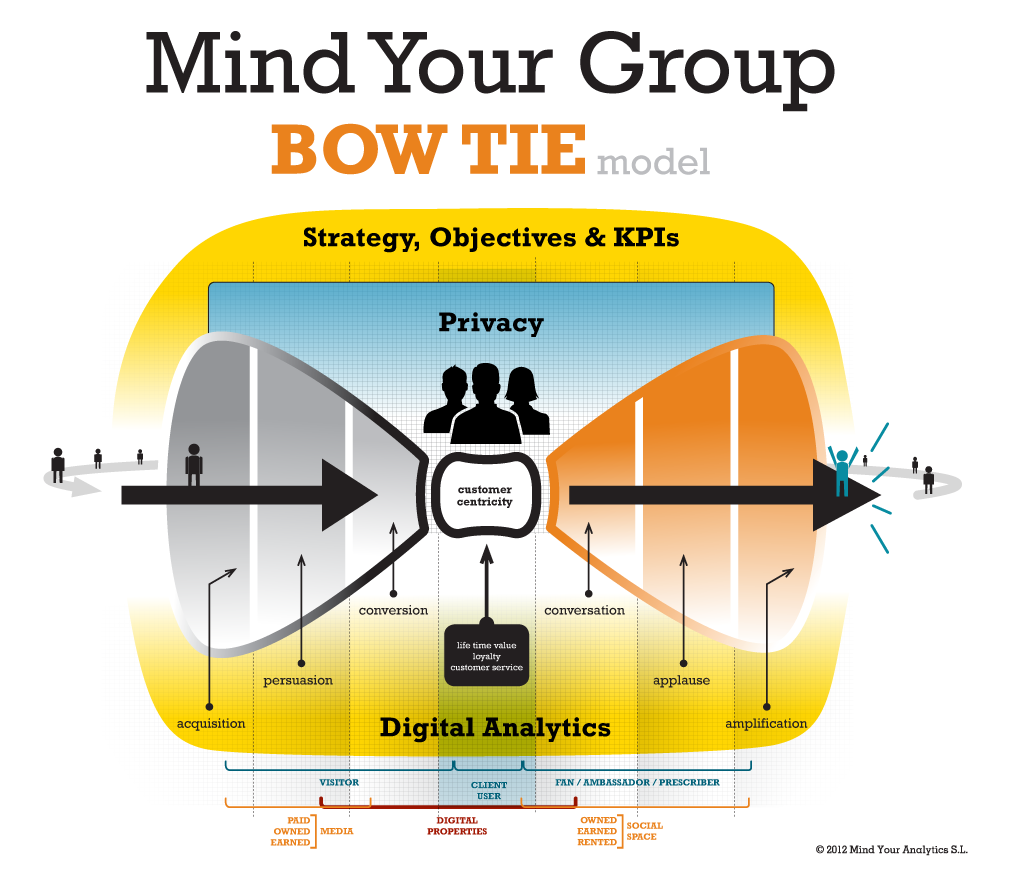
To define the online presence of any project, you need to start by reflecting on what your vision is and what you want to achieve. From there, you can trace the strategy and define the business objectives and the indicators you’ll use to track the online venture. In the graphic, this is the upper yellow layer that covers the whole thing.
If we look at the bow tie itself, you’ll see it’s a collection of states/stages you need to pass through: first, acquisition — any business needs potential customers, and on the Internet we talk about traffic. Once we have traffic, we’re going to try to persuade them, show them our value proposition, and once we’ve conveyed relevance and trust, try to “convert” the visitor into a customer, user, or whatever we’ve established as our conversion goal.
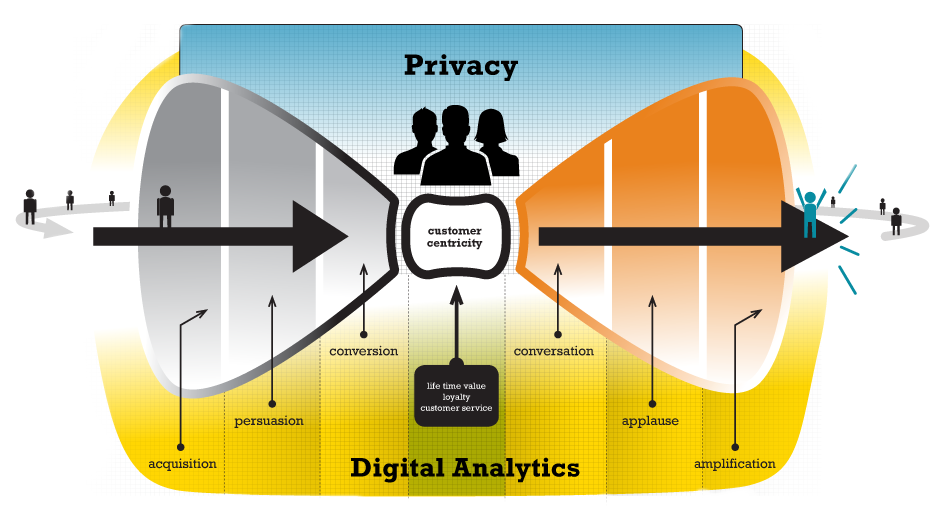
Once we’ve acquired the customer (center of the bow tie), in the digital world we have a multitude of possibilities to continue the relationship — not only to retain them but to turn them into advocates of our products/services. For this, we follow the process on the right side of the bow tie (in orange).
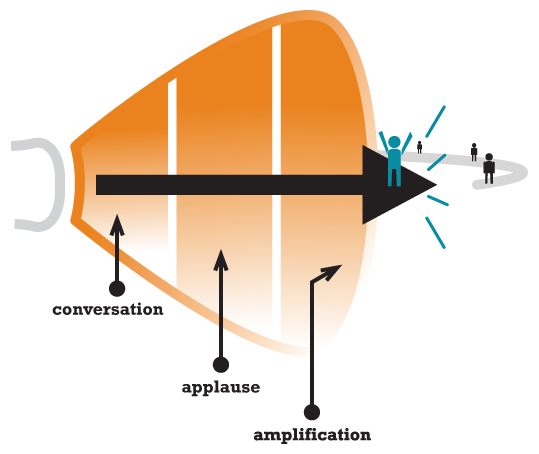
First, you need to establish a dialogue, a conversation with the customer. If that conversation is positive, it will probably be applauded, and the applause can be amplified. This process is very common on social networks. But be careful, because the same mechanism can be positive or negative (online reputation). If customers want to engage in dialogue with the company and it fails to establish that conversation, or the conversation isn’t satisfactory, negative applause and amplification can occur (if you’re interested in this topic and privacy, I recommend reading this Harvard Business Review post). Let’s also not forget that if those conversations are publicly accessible, they can influence future potential customers, so it’s important to pay attention.
By analyzing these processes in detail, as you’ll see later, it’s possible to “map” the different online disciplines onto the different parts of the MYG Bow Tie.

Above the bow tie, represented in blue, we see the current Sword of Damocles of the digital channel: privacy. The importance of good management and respect for privacy — not only to avoid sanctions but as a way to build a relationship of trust and permanence with our customers or users — is increasingly important, as evidenced by the frequency with which information about Internet and privacy appears in the media.
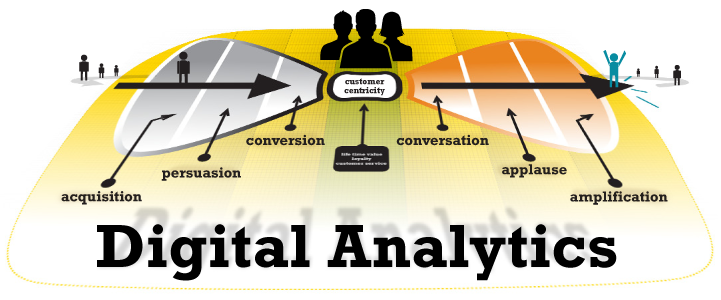
Below, as the foundation supporting the model, we have digital analytics. The entire process can and should be measured following the objectives and KPIs (key performance indicators) that have been defined based on the business strategy and vision.
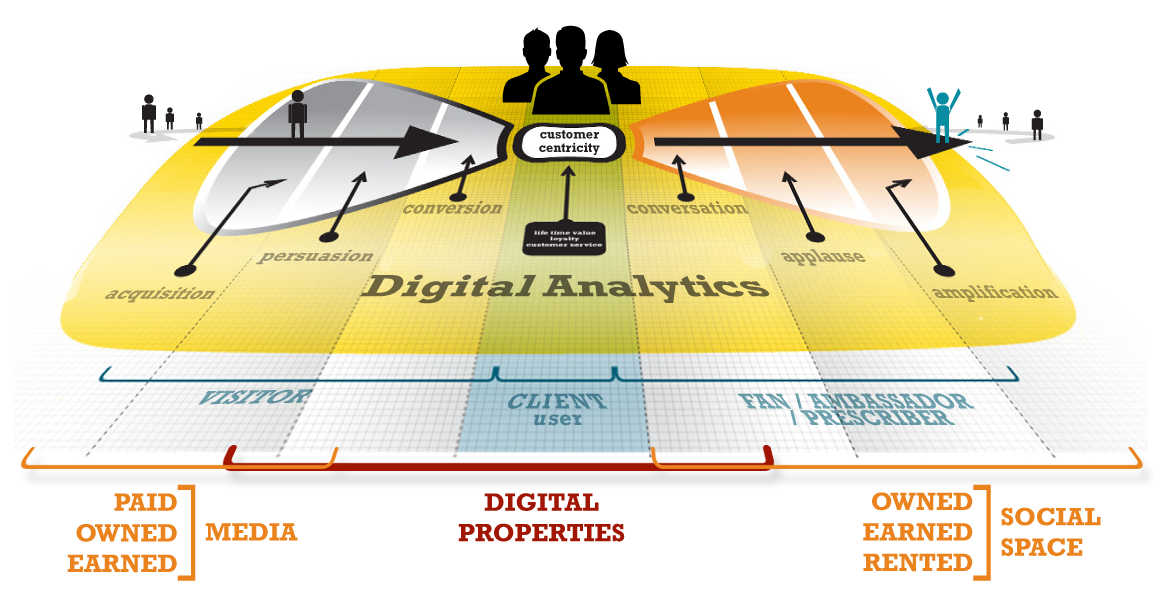
As you can see, if we look at the model from the customer/user point of view, they start as a visitor, become a customer/user, and ideally evolve into a fan, ambassador, and advocate.
From the company’s perspective, traffic acquisition uses mainly “media” of three types:
- Paid: for example, a banner campaign on a portal or a Google AdWords campaign (SEM);
- Owned: for example, a microsite you’ve developed or your YouTube channel where you upload weekly videos with tips or topics related to your business. These can also be offline media, like a poster in your physical stores.
- Earned: this refers to mentions of your company/products by third parties without any interested relationship, such as a blogger who decides to write about you or a press article.
Once traffic has been acquired, it arrives at the company’s “digital properties.” I don’t say website because depending on the case, the main online property might not be a website but a mobile app. It’s in these digital properties where conversion takes place, and ideally the company should take the opportunity to increase the value of each customer through good analysis of the different processes. Once the customer is acquired (from their own platform or from existing social media platforms), the company can generate conversation that can impact potential customers/users who feed back into the beginning of the bow tie as potential traffic sources, as well as retention of existing ones.
On social networks, we also have three types:
- Owned: the company may have developed its own social tools within its digital platforms. The problem with this model is that it’s usually difficult to attract community members, but if we succeed, the company will have access to all data and full control;
- Rented: the company can use existing tools like Facebook or Twitter. In this case, even though the tools are usually free, we’re talking about renting because we’re paying with our data (see my post “On Social Media Like Facebook, Your Company Is Just Renting” for more information). In these cases, the data usually belongs to the platform we use, and our access to that data is usually not as complete as it could be — not to mention that in many cases the networks where we post content become the owners of that content;
- Earned: the company can be mentioned by its customers on social networks, generating branding and even new potential customers (if you have a good strategy).
As you can see, this is a model we need to follow and constantly optimize once we’ve implemented it in our business. The digital world changes constantly and we need to stay current with developments to adapt the different processes, while staying alert since what works today doesn’t necessarily work tomorrow.
How We Use the MYG Bow Tie
At Mind Your Group, we use our bow tie to define the different services we offer our clients. The idea is to offer the full set of services needed to succeed on the Internet, while also allowing our clients to hire just one if they prefer. When we launched in March 2012, we started with web analytics services (the model’s foundation); then with Javier Godoy joining, we could offer the right side — online reputation and social media strategy services. Later, when María Gómez joined our adventure, we began developing privacy services — a project Aurélie and I had in mind since 2007; with Ricardo Tayar and his team’s recent addition, we expanded into persuasion, conversion, and parts of traffic acquisition. We still have a bit more to build, but we’ve almost fully developed the model.
The Internet Is Like a Big LEGO

When I say the Internet looks like Lego, I mean it for two reasons: one strategic and one tactical.
Strategy on the Internet is Lego: when you launch something on the Internet it has to be different from what already exists — it must bring something novel to the business model, processes, products… On the Internet, crudely copying what already exists doesn’t work. For example, in my professional life I’ve seen many entrepreneurs who came with the idea of copying a model that already existed abroad (usually in the US) and replicating it in their country. Most of the time it’s a failure because they haven’t even bothered to adapt the model to their target audience. On the Internet, copying doesn’t cut it — the Internet is Lego.
Tactics on the Internet are Lego: going back to the MYG Bow Tie model, if we take each part separately, we’re talking about tactical processes. For example, doing SEO isn’t strategic — it’s tactical. SEO itself doesn’t add value to the company; it’s a means to get traffic, which in turn aims to get, for example, new customers. Getting new customers is strategic; acquiring traffic is tactical.
When I explain the MYG Bow Tie model to our clients, I usually say each area is like a Lego color, and within that color there are different pieces. If we know all the pieces and colors that exist, we can create the Lego of our online presence. Imagine your online presence is like a big Lego set you have to build: if you don’t know the pieces and colors, you probably won’t build it in the most efficient way. It’s therefore important to understand the whole and know how the different pieces can be assembled, since the Internet is a hyper-competitive medium.
What do I want to share with the MYG Bow Tie?
The most important thing I’d like to convey with this model is that the digital channel must be approached as a whole, not just partially: it’s an ecosystem. If your company only does part of the bow tie — for instance, the left side without doing anything on the right — you’re wasting the opportunity to retain customers and turn them into advocates. If you don’t measure (if your company lacks the foundation), you might be succeeding, but you could succeed much more thanks to the information digital analytics can offer.
Don’t put on blinders — understand the whole even if you’re only responsible for one area.
For example, analytics and social media are usually seen as completely separate things, when in reality they feed each other. On the other hand, many companies see social networks as a traffic acquisition source (which they can also be) when it should be seen as a retention process. What your company does on social networks should ideally start with the customers/users you already have — that’s why in the bow tie we have the typical conversion funnel on the left, and on the right it’s reversed: it’s not a funnel but a megaphone (if you haven’t read it yet, I recommend Javier Godoy’s 3rd Generation Social Media Guide, and I’ll also leave you an Avinash post if you want to measure the value of social media). In most cases, a social media presence doesn’t make sense if you don’t yet have customers (left and center of the bow tie), and any attempts at this point will have no results or very poor ones.
We’re heading toward a world where transparency, choice, consent, and trust will be central to the relationships between companies and their customers/users and will ensure their survival. I’ll cover this aspect in more detail in an upcoming post where I’ll talk about the Digital Revolution and Data and the power transformation that’s happening as a result.
If you’ve read this far it means I haven’t bored you too much ;-) I’m currently writing a book that, among other things, presents this model in more detail. I’d love to know what you think, what your impressions are, and if you’d like to learn a little more about Mind Your Group, visit our new website!
Update 07/22/13:
Avinash Kaushik wrote his thoughts about the MYG Bow Tie on Google+ the day after this post was published, naming it the “Bow Tie Model for Digital Marketing & Analytics.” Avinash, who is a big fan of frameworks and models, said this was his new favorite and that it’s excellent for showing to any Marketing Director to start a conversation about where they stand right now and what they need to succeed on the Internet. You can read his full comment here.
I really like the name Avinash gave it and I may adopt it, although the model isn’t limited only to digital marketing as I explain in the book I’m writing, since on the Internet not everything is digital marketing.
Original Comments
Comment 1
Author: Marcelo Moreno (@marcemoreno) Date: July 17, 2013 Text: [Originally in Spanish] Great structuring René, thanks for sharing it! (In fact, I’ve stolen some concepts from you, citing you, of course!) Greetings from Argentina.
Reply by René Dechamps Otamendi (July 17, 2013): [Originally in Spanish] Hi Marcelo. Thanks for your comment (applause) and don’t worry — if you’ve cited me, that’s not theft but amplification ;-) Glad you liked it. Greetings from Madrid.
Comment 2
Author: Rafa Date: July 18, 2013 Text: [Originally in Spanish] Excellent model and explanation. I got here from an Avinash post on Google+. Thanks for sharing it with us ;-)
Reply by René Dechamps Otamendi (July 19, 2013): [Originally in Spanish] Hi Rafa, thanks for your comment and glad you liked it. Cheers.
Comment 3
Author: malbarda (@malbarda) Date: July 19, 2013 Text: Great model: it was published by Joseph Jaffe in his book “Flip the Funnel” in 2010. https://www.amazon.com/dp/0470487852
Reply by René Dechamps Otamendi (July 19, 2013): Hi Maarten, Thanks for your comment. Yes clearly Joseph Jaffe is a great inspiration for all of us. I’m not trying to solve all the world’s problems. What we did want to tackle is linking Social Media to Digital Analytics as they more often than not are seen separately. The customer is the key. Regarding The MYG Bow Tie model, my aim was to explain the different aspects needed to be taken into consideration by companies and organizations when dealing with the Digital world, thus it’s not just about the double funnel but also about what’s around it (Privacy, Data Protection). On the other hand I created the model to describe what we’re doing at Mind Your Group and our service offerings. Cheers!
Comment 4
Author: Cayetano Torres Date: July 20, 2013 Text: [Originally in Spanish] Excellent vision and clearly real. Very, very good!!! Cheers.
Comment 5
Author: [Trackback] Periferia Digital Date: August 8, 2013 Text: [Trackback] Cajón semanal de enlaces nº13 — includes “Internet es un ecosistema de procesos de negocio | René Dechamps”
Comment 6
Author: [Trackback] guioMetrics Date: August 29, 2013 Text: [Trackback] El éxito de un negocio online — “René Dechamps lo resume exitosamente en su modelo pajarita” (René Dechamps successfully summarizes it in his bow tie model).
Comment 7
Author: [Trackback] guioMetrics (updated URL) Date: February 5, 2019 Text: [Trackback] El éxito de un negocio online: marketing online — updated version of the same reference to the MYG Bow Tie model.
Before commenting, prove you're human: