Seven years ago I came up with a theory that I’m going to share with you in this post. At first I didn’t think much of it, but ever since, whenever I tell people about it, it sticks with them — and some have even adopted it.
I originally formulated the Lego vs. Playmobil theory talking about entrepreneurs, but over time I’ve realized it applies equally well to executives and employees.
The theory goes like this: there are two types of entrepreneurs — the Lego and the Playmobil. The Lego entrepreneur is a builder. The Playmobil entrepreneur is a manager.
The Lego Entrepreneur
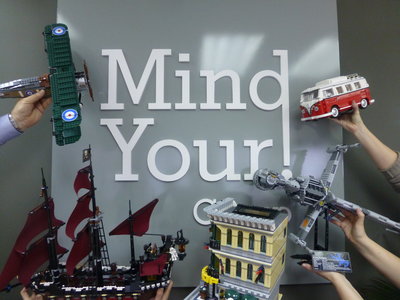
The Lego entrepreneur is a born creator. What they love is building new things, and the day-to-day management stops interesting them and erodes their effectiveness.
In this category you’ll find, for example, the entrepreneur who’s brilliant during a company’s startup phase but who after X years needs a change of scenery because they end up bored with the company they created.
It’s just like kids who have fun building things with Lego: what they want is to build, not play with their creations afterwards. Lego kids, once they’ve built a house, aren’t going to have fun playing family — they’re going to leave the house on a shelf and go build other things, until the day they need one of the house’s pieces. Then they tear it apart without a second thought. By the way, don’t ask that kid to build the same house again, because they’ll make a different one.
The Playmobil Entrepreneur
The Playmobil entrepreneur is a perfect manager. If you ask them to create a company from scratch, they might turn pale and not know where to start. However, they’re a perfect professional to take over the company the Lego entrepreneur created, optimize it, and make it grow and grow — or to work alongside the Lego entrepreneur, complementing each other.
It’s like kids who prefer playing with Playmobil. They’re not so interested in the assembly (it’s usually not complicated) — what they enjoy is playing afterwards, driving the fire truck from here to there making siren sounds, squeezing an imaginary high-pressure stream from the hose, or pulling into the gas station to fill up, paying with an imaginary credit card, and heading off on a highway adventure down the hallway.
A perfect business example for the Playmobil entrepreneur archetype is the franchise. All the “creative” part of the business comes pre-built, and you “just” have to manage it. There are also CEOs who are Playmobils and who manage large corporations.
Lego vs. Playmobil
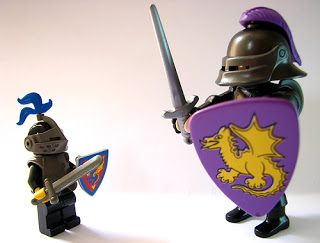
As with everything in life, there are no blacks and whites — just shades of gray. What I mean is that nobody is exclusively Lego or exclusively Playmobil. I’ve met people who are mostly Lego and people who are mostly Playmobil. However, I’ve rarely encountered entrepreneurs who are as good at creating companies as they are at managing them, though they do exist. In any society and business, both are equally necessary.
And Spain — Is It Lego or Playmobil?
You could say that in Spain, until now, the civil servant career has been valued more — that is, being a public manager, or working at a large company, preferably a multinational — above creating companies. This could be interpreted as an abundance of Playmobils and a shortage of Legos, as corroborated by a news item from February 28 of this year stating that 74% of Andalusian university students want to be civil servants.
However, things are changing in such a way that the country is going to need entrepreneurial people who create self-employment and jobs — that is, as many Lego entrepreneurs as Playmobil entrepreneurs.
The current crisis, more than 5 million unemployed, a mammoth and unsustainable public administration — these are realities that are making the paradigms that have existed in Spain until now obsolete. Today Spain needs new ideas to take advantage of the current situation and provide an outlet for the Legos and Playmobils that live inside Spaniards even if they haven’t known it until today.
The economic system fostered by Spain’s political-administrative organization, and consequently the culture that administration imparts and promotes through education, etc., is the reason many people don’t know they’re Legos, finding themselves forced by circumstances to work as Playmobils against their nature, taking jobs away from Playmobils who are much better suited for management.
Maybe one day we’ll discover that a region like Extremadura, which always comes in last in economic statistics, is actually a land of Lego entrepreneurs. After all, Extremadura has been a land of conquerors: Hernán Cortés, Pizarro, Hernando de Soto, and a long list of men from Extremadura who faced the unknown and discovered themselves and the world as magnificent Legos.
There are many Spanish Legos suffocated by centuries of inertia and corruption, since Spain’s Golden Age, which was golden exclusively for its literary, artistic, and cultural wealth, set against a backdrop of economic decline. The paternalistic Franco dictatorship period did nothing to change mentalities. Then with democracy we had periods of high growth, like the real estate bubble years where effort and hard work weren’t recognized — instead, people who made quick killings were held up as examples (not to mention the 16-year-olds who dropped out of school because after a couple of years in construction they could buy a Mercedes). The so-called “quick buck culture” has done a lot of damage to Spain, and the time has come to change society’s values.
At this crucial moment for Spain, we need resources, ideas, creative Lego spirit and managerial Playmobil spirit, because despite the crisis there are booming sectors that desperately need human and material resources to develop.
The solution to Spain’s crisis involves fostering private initiative, especially when there are more than 5 million unemployed who will need to awaken the Lego and Playmobil inside them, become self-employed, and create jobs.
I’m not a fan of omnipresent public powers in our society. However, given the severity of the crisis and the extremely high number of Spaniards without work, I believe the Spanish Government, which has a comfortable majority in Parliament, is morally obligated to create the foundations for a better future for everyone by investing more in education, removing obstacles and offering concrete measures for self-employment and small businesses that create jobs, and promoting research instead of cutting researchers’ budgets — it makes no sense to save money at the cost of impoverishing the quality and competitiveness of Spanish production and what future generations of Spaniards could create.
This doesn’t necessarily mean huge expenses — it means better management of budgets, carrying out intelligent and well-designed actions. We also need Lego politicians who launch coherent and effective solutions! Not just Lego politicians dedicated to “building party” and Playmobil politicians dedicated to managing public companies that drain Spain’s scarce resources and undermine the possibilities of Lego and Playmobil entrepreneurs who are eager to work and move the country forward.
Spain needs more Lego entrepreneurs to create companies and more Playmobils to manage companies in the midst of this crisis!
I Am Mostly Lego
This theory came about because I was a kid who was fanatical about Lego — I only wanted Lego as gifts, and watch out if anyone dared give me a Playmobil. What I liked was building things, not playing with them once I’d assembled them. Today I still build Lego sets, and our offices are turning into a toy store.
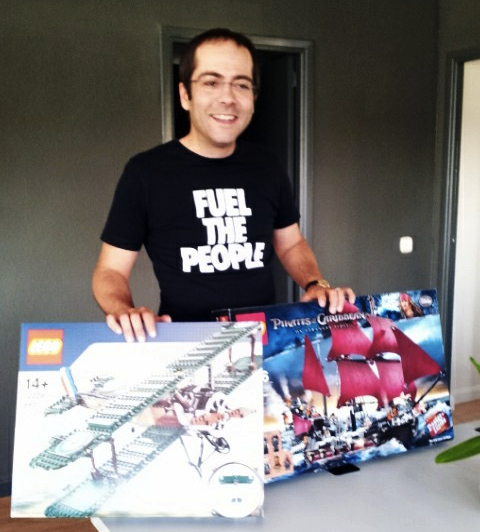
As a kid, my play space was filled with constructions and Lego pieces. The constructions didn’t last long — I always wanted to build new things. And I never kept the instruction booklets; once I’d built something, I knew I’d never build it the same way again.
Later in life, when I discovered at the University of Louvain what economics was and that what I really had was an entrepreneur’s blood, I realized I needed to create new things, that routine bored and demotivated me over time.
Mind Your Group = Lego DNA

At the end of last year, we launched the idea of creating a company with Aurélie and Gemma: Mind Your Group. It’s a set of hyper-specialized services led by top-tier professionals who collaborate based on projects and interests — who, like Lego pieces, can be combined in hundreds of different ways to achieve the desired results.
I knew I had to create something more than an analytics company, since, as they commonly say in English, “Been there, done that.” That’s how the idea was born to create Mind Your Group, a group of niche services. With the right structure, it guaranteed I wouldn’t get bored — I could launch new ideas and move from one service in the group to another to add my grain of sand and maintain the creative, builder spirit. And that’s what I’m busy with right now, building and implementing ideas, and even though times are tough, I have to admit I’m having a blast.
And You? Are You Lego or Playmobil?
What type of professional are you? Lego or Playmobil? I’d love for you to share your opinions in the comments so we can all refine this theory together.
In the meantime, enjoy — and if you were a Lego enthusiast as a kid and want to check if that inner child still exists, I recommend Lego for adults (the R2-D2 is amazing). When I build Legos, I feel like a kid again ;-)
P.S. In my next post I’ll explain the vision behind Mind Your Group and why the Internet is an ecosystem that looks a lot like Lego.
Original Comments
Comment 1
Author: iggodin Date: April 2, 2013 Text: [Originally in Spanish] Absolutely agree. Without a doubt, the sweet spot is in the middle. Playmobils without Legos wouldn’t know how to start the story; Legos without Playmobils couldn’t continue it. And now a question: Is it/Would it be valid to build a business model based on these profiles? Just putting it out there. Great post René!
Reply by René Dechamps Otamendi (April 4, 2013): [Originally in Spanish] Hi Nacho, Thanks a lot for your comment. Forgive me for not responding sooner — I’ve been moving the last two days and Telefónica still hasn’t installed Internet in the new house ;-) As I say in the post, I totally agree with you, you need both in any company. Answering your question, I believe yes. In my experience there are people of both types (although never 100%) and hybrids. But I’m not a professor, so maybe I’m not the best person to evaluate it ;-)
Comment 2
Author: [Trackback] TodoStartups Date: April 2, 2013 Text: [Trackback] Empresario Lego vs. Empresario Playmobil #tsNews!
Comment 3
Author: Lucía Hernández Date: April 2, 2013 Text: [Originally in Spanish] I enjoyed reading this post. And a smile crept onto my face, unstoppable, remembering that playroom in the basement, with a peculiar bag-blanket that you could gather by just pulling a string… that when unfolded opened an entire world of possibilities… a world of LEGO!!!! And there was René… Maybe I’m more of a woman in the gray zone you talk about in this post, but toward the Playmobil pole — I tremble and turn pale when designing the origin of a project from scratch, but I enjoy it if I have a Lego archetype nearby who transmits their enthusiasm and shares their creativity… and surely I also have much to contribute in that process, at different moments. I think this nice analogy helps define people professionally and create mixed teams to optimize the abilities of both types.
Reply by René Dechamps Otamendi (April 4, 2013): [Originally in Spanish] Hi Lucy, How many hours we spent playing with Lego… ;-) Thanks so much for your comment which brought back many childhood memories for me too. Being Playmobil isn’t bad — it’s needed, and as you say, a Playmobil can also contribute ideas. A kiss from Madrid! René
Comment 4
Author: Victor Date: April 2, 2013 Text: [Originally in Spanish] Very good!! I feel LEGO to the bone… Sharing with your permission.
Reply by René Dechamps Otamendi (April 4, 2013): [Originally in Spanish] Víctor, glad you liked it and that you identify with the Lego analogy. And thanks for sharing — that’s what it’s there for.
Comment 5
Author: nayrapv Date: April 3, 2013 Text: [Originally in Spanish] I loved it. Too bad I didn’t enjoy both options in childhood (I’m not sure why… because I’m a woman? because I had other options that caught my attention more?) Now I’m discovering it with my son, and while I concentrate and struggle to make Lego figurines, he plays with what I’ve built with his father… Very revealing. On all levels!
Reply by René Dechamps Otamendi (April 4, 2013): [Originally in Spanish] Hi @nayrapv, You probably didn’t enjoy Lego in your childhood because we have to admit that back then building toys were more of a “boys” thing (without wanting to offend anyone). Now there’s a “pink” Lego line as I call it, and I know several girls who have a blast building little houses. As for playing with his father, it’s probably because of the memories it brings your husband. When I play Lego with my son I never get tired ;-)
Comment 6
Author: Patricia Date: April 3, 2013 Text: [Originally in Spanish] I enjoyed reading this post and remembering the good times I spend with my son building sets — without a doubt he’ll be Lego. I’m still Playmobil — when I finish building them I need something more… I’d never thought about things from this angle — I have to admit it’s fun and inspires creativity.
Reply by René Dechamps Otamendi (April 4, 2013): [Originally in Spanish] Hi Patricia, Glad you enjoyed it. The truth is I didn’t know if the analogy would resonate with a public that doesn’t know me, but I see it does. Thanks for your comment — it made my day — and for the encouragement.
Comment 7
Author: ahorroyreciclaje Date: April 3, 2013 Text: [Originally in Spanish] I loved this post. A great article to share. Congratulations!!!! I am Lego!!!!
Reply by René Dechamps Otamendi (April 4, 2013): [Originally in Spanish] Hello “Modern Working Mom” ;-) Glad you liked it and that you identify as Lego. Thanks.
Comment 8
Author: astrid Date: May 27, 2013 Text: [Originally in Spanish] Thank you so much… this will help me with my assignment “the entrepreneur as manager”… engineering student in business management…
Comment 9
Author: Andres Fioravanti Ortiz Date: June 3, 2013 Text: [Originally in Spanish] I really liked your article René. The truth is I’m going with Lego because it’s been with me since I was little. In my country (Colombia), we didn’t have Playmobil. Too bad there isn’t much Lego culture here in Madrid. I don’t feel 100% fan but definitely 75.99% haha. Can you work for Lego in Madrid? That would be great for me.
Reply by René Dechamps Otamendi (June 15, 2013): [Originally in Spanish] Hi Andrés, thanks for your comment. As for working for Lego in Madrid… I don’t think Lego has its own presence in Spain. You could ask Juan Macías who was Lego’s ambassador in Spain. The person in charge of Analytics at Lego in Denmark was an intern at my previous company in Belgium — I’m chasing him to see if they ever have a project we could collaborate on. As you can see, our aspirations are aligned ;-)
Comment 10
Author: [Trackback] vecinolisto.com Date: June 8, 2013 Text: [Trackback] ¿Y tú? ¿Eres Lego o eres Playmobil?
Comment 11
Author: Silvana Date: June 17, 2013 Text: [Originally in Spanish] A pretty interesting analogy. Not long ago I was questioning why since childhood I’ve preferred Playmobil over Lego (a taste I keep at 30) and I reached a very similar conclusion to what you propose in your article — I loved it. It’s partly a personality thing, and partly innate capabilities that we reveal from childhood in things as simple as choosing a toy, and that as adults we often struggle to identify. But if we detect those strong pillars we can get a lot of benefit, and of course, look for the complement. Greetings and a kiss from Mexico City.
Comment 12
Author: toner hp Date: January 5, 2014 Text: [Originally in Spanish] Certainly the combination of both in the same person is difficult, but… you can try.
Comment 13
Author: [Trackback] Apóstrofe Comunicación Date: March 28, 2014 Text: [Trackback] Las 3 últimas lecturas más inspiradoras
Comment 14
Author: [Trackback] Blog Vecinolisto Date: April 16, 2014 Text: [Trackback] ¿Y tú? ¿Eres Lego o eres Playmobil?
Comment 15
Author: Victor Campos Date: July 25, 2014 Text: [Originally in Spanish] I love this post — it’s the second time I’ve read it! Long live the Playmobils! haha. You’ve managed a very fun read within the business world — congratulations on the post! Sharing it.
Reply by René Dechamps Otamendi (July 31, 2014): [Originally in Spanish] Hi Víctor, Thanks for your kind words — I’m honored you’ve read it twice ;-)
Comment 16
Author: Ábacus Consultoría de Edificación Date: March 25, 2015 Text: [Originally in Spanish] What if there were a third profile beyond Lego? I’m referring to the “creative” — people who naturally make something from nothing, not even the base bricks. After all, Lego conditions your result from the start since it’s built on a modular system of shapes, colors, sizes… A well-known case is Picasso, who could draw and paint perfectly in the classical model of representing reality, but whose “soul” demanded he create a new form of expression without settling for what existed until then. And from that came what was later known as cubism.
Before commenting, prove you're human: